subscribe to follow along
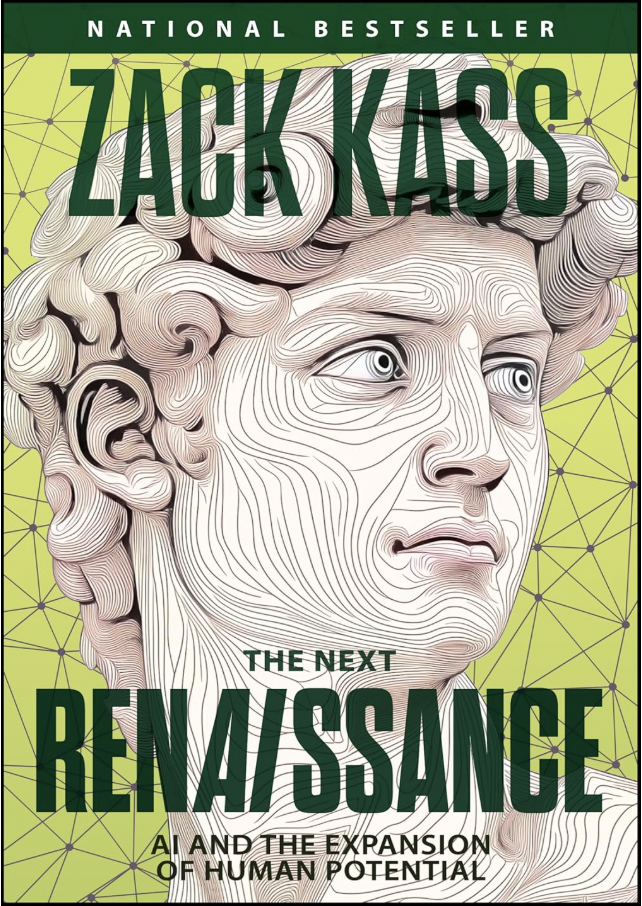
The Next RenAIssance
Zack Kass
This book is primarily about leverage and expansion. The leverage that AI gives us when we deploy it at scale across sectors, industry and lives, and the expansion it provides not just to grow and learn, but to become more human, more optimistic, more ourselves.
Kass is describing a new renaissance – a RenAIssance – a new period of prolonged change where our world is being “fundamentally transformed.” This change, he will argue, is opening up new and distant horizons
He starts with an overview of where we are and what has led us to this moment of agentic possibility (“we can’t chart where we’re going without knowing where we’ve been”): the history, the building blocks – from the 60s when ideas of super intelligence were emerging, to Facebook recognizing faces to ChatGPT answering questions in seconds. Zack Kass has had a front row to much of the evolution of artificial intelligence over his life working in the field and being at OpenAI at the genesis of ChatGPT.
He talks about the new power we have the ability to harness: “startups around the world can now build without venture-scale infrastructure,” he goes on: “the world is paying less for far more intelligence.” For Kass, “progress does not leap from primitive to perfected” – we still have a long way to go. These capabilities, however, are giving us more independence, more time, and more information.
AI “collapses the cost of action” and compresses timescale. It will be up to us to make the shift to harnessing it and using it wisely: “The bottleneck will shift from scarcity of intellectual power (compute), to the effectiveness of producing with it.”
In the first half you will not only learn about the history, but the ways in which AI is understood philosophically.
The second half of the book explores AI in terms of finance, education, healthcare and work. Back to the idea of leverage: how should we deploy it and what does that mean for capability and possibility?
Finance:
- The role of RenAIssance here will be to shine a spotlight. It will not only help people build wealth, it will increase literacy, access and remove the “veil that allows financial predation to thrive.”
Education:
- The role of the RenAIssance in education: it will be transformative. It’s not a “replacement, but a restoration.” He wants to give teachers back their time, give children more access to play and social interaction by increasing supports through AI tutoring and targeted instruction.
- He is very pessimistic on the current state of education, and while I think his warnings have merit, I do not see the picture as bleak – rows of desks, factory like learning. But I get it! It’s just not as bleak (I am in a lot of classrooms in my role leading an education nonprofit, and see a lot of ingenuity and creativity. But his assessment is halfway correct and his response is powerful.)
- AI can help support “assessment that is continuous, multimodal, and explainable.”
- He was best in this chapter on the ideas not of tearing it all down and starting over, but by finding ways to reshape education from within. I am a big fan of finding key levers within existing systems.
- He sees abundance for the future of AI in education: we could use it to “expand opportunities”
Healthcare:
- The role of the RenAIssance in healthcare: “restore precision to the science, prevention to the system, and presence to the bedside.”
- His suggestions focus on the integration of data, so that we can “tailor treatments to the individual rather than the aggregate.”
- This makes intervention and support accessible not just during yearly visits, but across your life because of the ability to continuously measure, predict, and assess – through wearables, reminders – “prevention becomes actionable and active, not aspirational.”
- AI offers the chance to “untangle” the web of administration: automating paperwork, managing logistics… giving doctors, nurses and professionals time and the power to refocus on what makes their work meaningful.
- He points to apps like Curai that are scaling fast. It’s an AI intake system that allows physicians and clinicians to review the information and connect with patience within minutes. The point for Kass isn’t replacement, rather, “access” – care should be accessible. What we will run into as far as a crucial challenge is “time” – AI tools like Abridge that listen and help doctors take notes allow them to be more preset.
The Future of Work:
- We all know there are and will be major disruptions and job loss because of AI. There were some compelling arguments here that it won’t be as widespread and immediate. Most powerful is his quote from Nvidia CEO Jensen Huang: “You’re not going to lose your job to an AI, you’re going to lose it to someone who uses AI.”
- AI is a tool, like many before it, that “shifts the boundry between human effort and machine support” – think the calculator, making math accessible at scale. The spreadsheet. AI is a much faster speed and scope than these advances, however, the augmentation it provides is not just accelerating the pace of our work, but raising expectations on everyone.
- His advice? “The people who will thrive will be those willing to adapt their practices, experimenting with new ways of working, and abandoning habits that no longer serve them.” Aka: behavioral adaptability.
- We will see “new work:” which will actually look like a return to old work. Machines will absorb transactional and computational roles, humans will continue to provide artistry and experience. Handmade will become more premium. Authenticity will be valued and more central than ever. The new work, he argues, is actually impossible to imagine in full. Just like one hundred years ago we couldn’t predict jobs in cybersecurity, so today, we will be seeing new roles never before imagined. Entirely new categories that will be available to the next generation: “AI will not end work, it will expand it” and it will “push ust to knew ways of creating connecting and adding value that are invisible to us today.”
AI is about expansion. For Kass, what we are expanding and building is “human optimization.”
He ends with practical advice:
- Go outside: “be human with a human body.”
- “learn how to learn” – don’t worry about majoring in the “right thing” – major what “you’re willing to obsess over.” Have the humility to say “I do not know yet.”
- Be human: AI will force us to have greater courage, compassion, humor and wisdom.” These soft skills will be the future “primary means of differentiation.”
- Lead with optimism: “people build toward the stories they believe. Narrative sets policy, Belief sets budget, a leader’s horizon becomes a team’s boundary conditions.”
The end was my very favorite. We have to build with optimism. We have to believe in a world that is shaping toward progress. “If we tell stories of decline, we will write rules that constrain. If we tell credible stories of a better future, we will invest, upskill and move. Optimism builds lasting progress.”
For Kass, AI is already expansive, and it will “continue to expand what it means to be human.”
LOVED this book!