subscribe to follow along
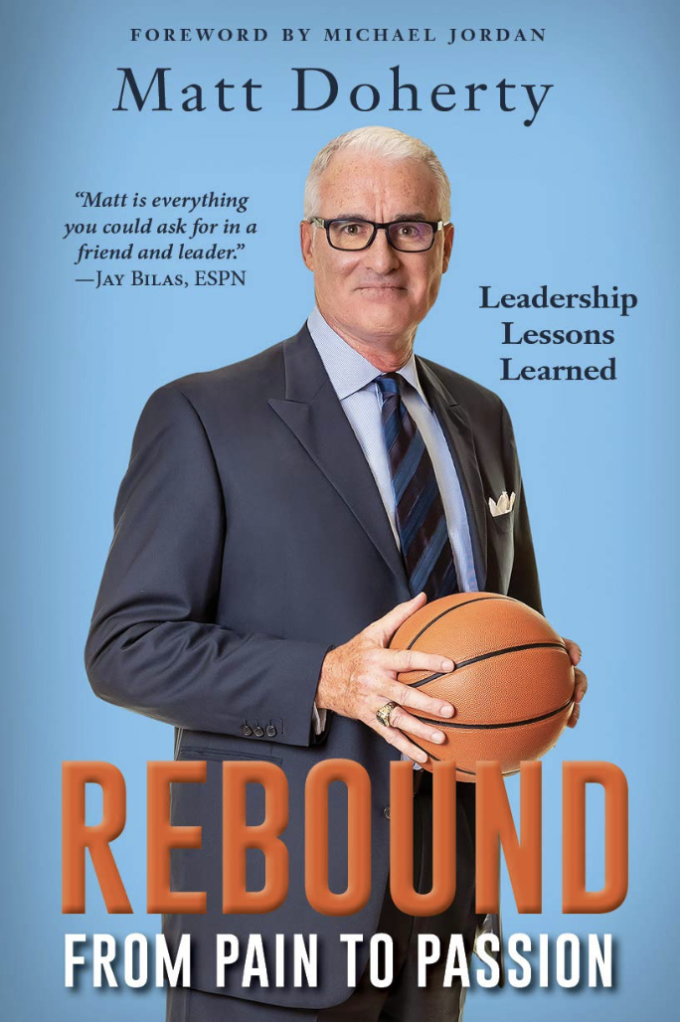
Rebound: from Pain to Passion
Matt Doherty
“After losing my job, I had a decision to make. I could become bitter or I could work to get better!”
I love basketball, I love leadership, and I love this book. Coach Matt Doherty writes, in Rebound: From Pain to Passion, about a journey that we all inevitably face – rejection, loss, learning and reinvention.
In the book’s forward, Michael Jordan, his former teammate, shares: “Matt helped teach me how to really think about the game of basketball, not just use my skills to play.” In his writing, he does the same for us. He helps us how to really think about leadership – the highs and lows, the losses and wins.
The journey begins with his father, who taught him words that would continue to shape him over a lifetime: “When a coach is correcting you, don’t say ‘I know.” Doherty remembers these words and the way they would shape him: “my dad was teaching me how to be coachable.”
Basketball was at the center of his life from an early age. “The thing I loved most about basketball was that I didn’t need anyone else to improve. I could work on my game by myself to get better.” From there he grew as a team player as well: “I learned about playing a role.” On the court, playing until dusk in the neighborhood with players that were better than him. “I learned to listen.”
He would play all of high school and got to “cut down the net” at St. Agnes: “dreams do come true.” He committed to UNC in 1979, heading to North Carolina from his home in New York to play for Coach Smith. Michael Jordan would commit the following year. After playing, winning, and leading the team to excellence, he would then begin his next journey that would eventually lead to coaching, and making the big decision to head to lead the team at UNC, returning not as player but as head coach in 2000.
Taking over from a moment of legacy, form someone larger than life, from his own coach, begins the next chapter of his journey, and where some of his best lessons about handling the pain of loss.
He recognizes what he took on. He was becoming “the caretaker.. of an institution.” Managing change and being the public face of it to a group who had been loyal to Coach Smith, who had for more than a generation, been the respected architect of a high performing team. He was inheriting a culture, and coaching in a building named after his predecessor who would still have an office upstairs. Not an easy task.
Turns out, after three seasons, his career at UNC came “crashing down.” He shares in the book the layers that led to that moment, but he is most powerful in his discussion of what he did next, and what we can do, to take “the bridge over bitter river.”
He struggled for years with the pain of being forced to resign at his alma matter. He would dream of conversations. Moments he would want to redo. We have all been there. But he also spent a lot of time reflecting, moving forward and turning his pain into purpose. Helping others handle loss. Sharing his journey of failure so others would have a friend on theirs.
I think his best reflection in his narrative is on legacy. Following his forced resignation, he attended a class at Darden and looked at a case study about a CEO who came into a family business from outside the organization. “He sat down with the employees and was slow to make any drastic changes. He managed change appropriately.” He learned about a similar process built into the transition moments in his Presbyterian Church: their standard is to find an interim who doesn’t make major changes, but rather prepares the way, listens, and helps build what is next. These are he wished he had learned before coaching, and what has ignited him to build a life of supporting others in their leadership roles across organizations.
He reflects on what he might have done differently had he had this training. Particularly around staffing. He had immediately decided to bring his team from Duke. His coaching staff who he loved. “I should have taken my time, consulted my ‘personal board of directors’, discussed it with Dick Baddour. I should have kept the UNC staff in place.”
He also reflects on how he should have worked harder to stay connected to Coach Smith –– he was handed the keys to that locker room, but he should have recognized the power and the opportunity of shepherding that legacy more carefully.
He is honest about the regret, and the frustration with the way he was treated across those three seasons, but his learnings and reflections what he might have done differently is powerful and a gift to all of us who are going through or will one day go through this type of moment of legacy.
My favorite ideas from Coach Doherty:
- One of the reasons you coach: “pushing players out of their comfort zones to achieve success they couldn’t have imagined!”
- “You have to mine for the truth.”
- “It is very important for a leader to show strength and hope during a crisis.”
- “Perspective is important during difficult times.”
- Leaders need to figure out how to turn a negative into a positive.
- My brother John says, “make failure your friend.”
- He shares his favorite advice from coach Paul Brown: “When you win, say nothing. When you lose, say less”
- This sentence would change my life: “leadership is a learned behavior.”
- “I had to learn to forgive others. They were “renting space” in my head and my soul.”
Doherty talks about failure across the book with raw emotion. It is powerful, and sad. But he moves through it by facing it and helping us learn how we can face it as well, “as a player and coach, you fail often, and your job is to ‘study the tape’ to get better. This is his way of letting us study his tape, and I’m thankful for that opportunity. A great read.