subscribe to follow along
the road less stupid
Keith J. Cunningham
This is the best business leadership book I have read this year. Keith Cunningham is incisive and doesn’t mince words. He is exacting, direct, and brilliant. He vulnerably shares that at one point in his life he lost everything – his fortune, in many ways, his identity – and after growing angry, he woke up and realized he had to make a change. He said hell on earth would be one day meeting the man you could have been.
“The question is not, ‘How do I win this game?’ The question is, ‘How am I going to play the second half?’ I am not going to win this game, but I do have an opportunity to decide how I will play it.”
Spoiler alert, he rebuilt himself, his business, and he shows us the way. And the way, it turns out, is the road, less stupid.
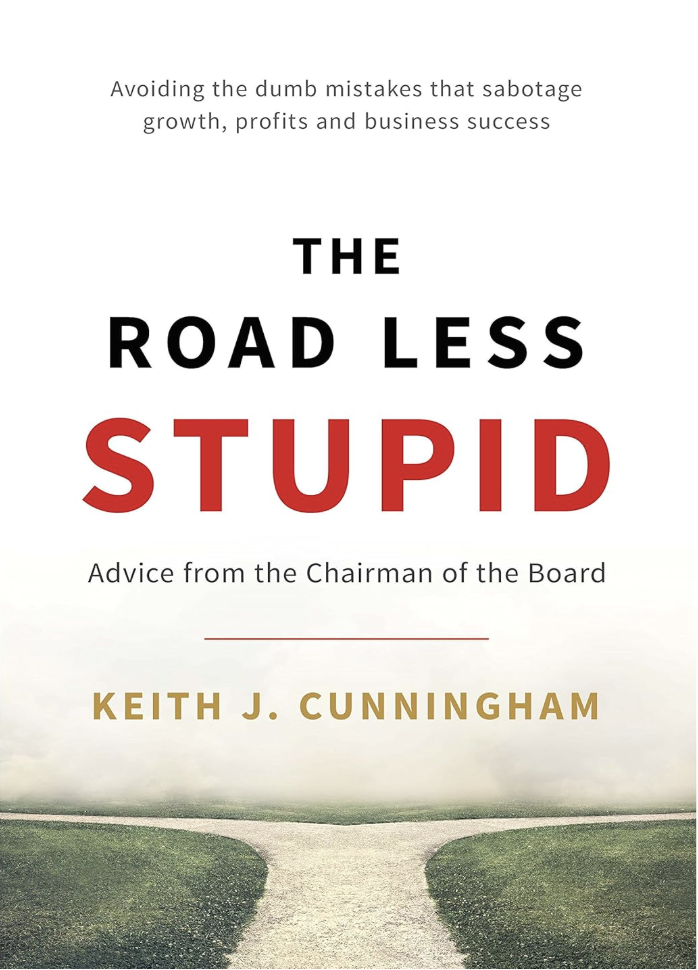
For Cunningham, “business is an intellectual sport” and he works to help remove emotional impulses, and help his readers build thoughtful decision making into their very day – each chapter ends with a list of questions that he encourages you to sit and ponder, a daily practices he calls “thinking time” for ten minutes, in silence. I’ve done it, it’s amazing, and his questions will stay with you throughout the day as you turn them over in your mind and build the muscle for decision and action. His thinking time questions are built out of his five core disciplines of thinking: find the unasked question; separate the problem from the symptom; check assumptions; consider the 2nd order consequences (clarify the risks and the possibility/cost of being wrong); create the machine (the executable plan and the resources you need to move forward.)
He’s big on taking these steps to learn and grow: “if you want to do better, you must get better.” You must commit to excellence and mastery.
Take ownership of your life and learning.
“How you do anything is how you do everything.” He quotes his friend Harv Eckler here and believes that you must own the job you have, and work to consistently get better at it. “In your life, you are the CEO of you.” If you were a publicly held company, what would your stock be doing? Own your job, and own your growth in that job.
Experience matters.
I learned so much from him as I developed my framework for leadership, Lead with How. Lived experience matters. How people feel in your organization, in your presence, matters. “Culture is not values or mission statements… culture is how we treat each other, how we talk to each other, whether or not we trust each other, and how we handle conflict.” The key is a never-ending conversation about the rules, the experience of the game. How you deliver a solution matters: the experience and execution.
Getting clarity across the organization is essential: “Generalizations kill clarity. Clarity equals power. Power is the ability to act.” The CEO is responsible to help people get clarity on going from point A (having a clear understanding of where the business is today) to Point B (the vision of where it should be in the future.” Clarity about reality is rare.
How matters: “Your success will have very little to do with what you do and everything to do with how you do it.” How you treat your customer matters, how you roll out your business and meet their needs matters, “the customer gets to define success.”
Always start with the customer.
Where he really shines is in his vision for customer obsession. “Optimizing for passion and product perfection instead of customer needs and demands is a classic business mistake.” His best line: “instead of falling in love with our products we would all be more successful if we fell in love with our customers and their outcomes!”
“Start with the customer then work backwards.”
On growth.
“Getting big is the result of success. Success is not the result of getting big.” To grow, you need to build predictable streams of revenue.
The key here, across the board is your belief. “Mental belief and optimism are critical to high performance.” Balance this with planning: “business is personal, not emotional.”
Your job, as the leader of an organization, is to plan, optimize and build leverage. “carefully and selectively prioritize the few strategies and initiatives that will optimize the financial performance of the business while simultaneously leveraging the resources available.”
Business is chess, not checkers. If you build a sustainable model, blend that with passion, but remain clear eyed, you will build the conditions for success: “the chance of success goes up when you think, plan, consistently execute the right things, and worry about the possibility of loss.”
A key on growth? “Start where you are. Don’t let perfect get in the way of possible.”
A few of his best quotes:
- “The problem with drama is that it always costs money.”
- A description of the destination is not a substitute for the road map, or the machine, that will get me there.” ( you know I love this!! “How” matters)
- The four primary roles in business success that. Must be played: Artist (creator); Operator (technician); Owner (business); and Board (Investor) – you must wear each hat, you must not let each role define you, and they each require you to take on a different mindset that you can learn.
- “Procrastination magnifies problems.”
- “Marketing is about getting people to notice what you do. Execution is about doing something people will notice.” (Strategic growth requires both!)
- “Ordinary things, consistently done, produce extradentary results!”
- “We self-sabotage when we look for one massive thing that can be the game changer.”
- “Leverage means doing more with less.”
- “Invention happens in the laboratory. Innovation happens by engaging with the market.” You are always balancing your dreams/goals with the realities of the market. Recognize the gap in the market, and where you can fill it. Stay “nimble, inquisitive, and responsive.”
- The problem with many companies is that they lose relevance: “they continue to grow, but fail to evolve.”
- Don’t abandon the advantage of being small. “small destroys it’s only competitive advantage by attempting to emulate the big guys.” Stay curious, humble, and flexible. “Flexibility requires an acute awareness of where you are in relationships to your environment.” Continue to please the niche,
Some of his best “thinking time” questions:
- What are the things I would be doing if I wasn’t afraid of losing?
- How do customers think and talk about my business?
- What are the growth opportunities that I have been postponing because they require extra effort or are outside of my comfort zone?
- What would I do if I had $1,000 to spend on a solution? $10,000? $1,000,000?
At the core this book is about building and scaling sustainably. It is a field guide, a manual, something you will refer back to: “There is a big difference between success and excellence. Success is getting there. Excellence is staying there.” This is a book that will help you get there, and stay there.