To innovate, you must partner.
“Organizations must partner or die.”
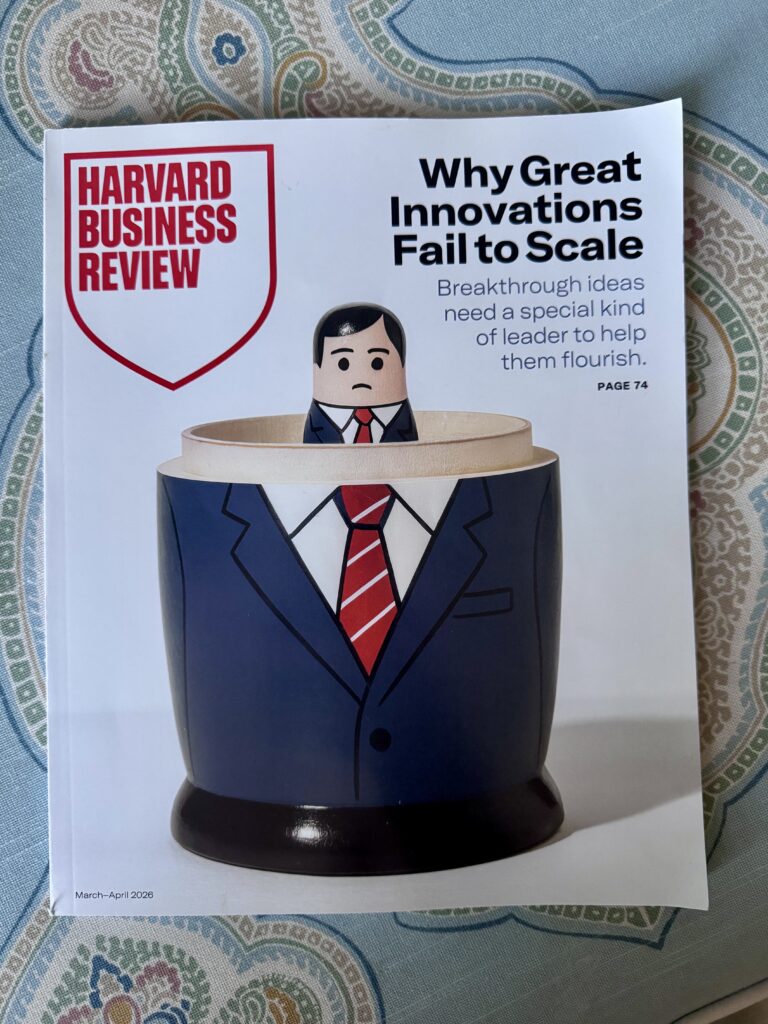
Innovation is imperative, and it requires collaboration to execute both internal and external partnerships. You can’t just see the pathway; you must build the leaders who can take on this type of journey for the organization.
In the most recent Harvard Business Review, Linda Hill, Emily Tedards, and Jason Wild write “Why Great Innovations Fail to Scale”, explore the complexities and complications of building coalitions and collaborations to deliver and scale services. Pace is often significantly reduced because it can be “painful” to “work across organizational boundaries.”
They are interested both in the structure needed to scale at pace, and the type of leadership this undertaking requires.
Most importantly: who can do it? What kind of leadership is required to create the social connections needed to build the trust required to bring organizations together to collaborate and scale? Their answer is “bridging.”
“Bridgers have strong emotional and contextual intelligence, which enables them to build trust, influence, and commitment across partners that are essential to move innovation forward.” At the core of the work of a bridger is relationship building.
When you place a bridger in the role of helping an organization scale, they can do so with speed because of three main factors: they curate partners, translate across boundaries, and integrate partners’ disparate efforts.
They are also skilled at cultivating:
- Mutual trust (crossing boundaries makes people feel vulnerable; bridgers create safety, an environment where people are willing to try, fail, and take risks).
- Mutual influence (building joint ownership, gathering ideas and answers while balancing for speed).
- Mutual commitment (standing alongside your team and partners to fight fires as they arise).
Curate Partners
- Cast a wide net and build relationships across sectors and contexts.
- Earn trust by listening deeply; in every conversation, try to see the world through their eyes.
- Empathize with stakeholders to understand the risks they would carry if you were to partner together.
Translating Among Partners
- Recognize that each partner has different priorities, and instead of trying to minimize differences, seek to uncover them through dialogue.
- Bridgers rely on “strategic storytelling” to make future opportunities tangible for stakeholders.
- Appreciate and learn what others value, fear, and care about.
Integrate Partners’ Disparate Efforts
- Address the practical challenges of partnership.
- “Define a shared intention, or north star,” before working to coordinate efforts.
- Bridgers, although diplomatic, must maintain a “ruthless focus” on what it will take to move everyone forward.
Beyond simply defining everyone’s north star is the constant work to remind and reinforce the shared vision. This is what the authors call “building the social glue” – linking shared vision and shared priorities through story. This keeps partners energized, focused, and aligned. When a project stalls, when resistance arises, the ability to point back to and remind everyone of the shared ambition is vital.
So now we know more about the leadership identity, the work of the bridger, required to innovate. How do you cultivate and create that kind of leadership ability in people?
Bridging is demanding. And this is the type of person you need throughout your company and across the organization. The challenge is linked to the task: “Bridgers focus on making their partners the heroes,” and therefore it can be hard to claim contribution. This is why supervisors must recognize and reward the bridger.
To find and develop bridgers:
- Look for people in your organization who already work across boundaries. They volunteer outside the organization; they build teams across departments.
- Encourage involvement in external communities. This exposes leaders to different ways of building and collaborating.
- When you place a bridger in a role, “give them air cover.” You must nurture, recognize, and protect the work they are doing. Executive backing empowers and protects the bridger.
- “Give bridgers visibility.” This sends the message that innovation is encouraged and welcomed.
- The authors explore these ideas on leadership and innovation in their book, Genius at Scale, which I can’t wait to read.
I just about jumped out of my seat every other paragraph of this brilliant article. This has major implications for the nonprofit sector and for partnerships across business and industry to push forward the social initiatives needed to build thriving communities.
Just a few thoughts:
- To build and scale social innovation requires partnerships, but I would argue it doesn’t require individual organizations to change their mission. Rather, they must lean fully into their identity so they know what they are good at and what they are not. Then they can more effectively work across organizations to collaborate and build pathways to deepen impact while staying committed to their individual operational models.
- To build bridgers, you must encourage leaders to work across difference. This is why you join leadership organizations, nonprofit boards, Rotary clubs. You engage the muscle of partnership and collaboration when you expose yourself to different structures and build shared mission in new contexts. If you want to innovate at the pace of today’s business environment, you have to learn how to recognize patterns across different leadership and organizational structures.
- Vision. Vision, vision, vision. Getting to a shared vision and then understanding the different modes of being that everyone must take on to achieve that vision means you must, as an organization, develop a clear Impact Model and learn how to Lead with How. This is my bias, of course, because I see across the board how the framework I am developing helps organizations claim their identity so they can move forward toward shared vision. When you understand your particular way of operating and how that achieves the goals you have — how that builds the world you want to live in — you have incredible opportunity to partner. Shared ambition is powerful because we begin to see value in the identity of others and in the work we can accomplish together. But to do this requires a deep understanding of the strengths of each model and a willingness to build frameworks for partnership.
Bridgers are people who build coalitions, share power, and translate vision. Recognizing their work, cultivating their leadership, and empowering and supporting them is the pathway to moving at the pace needed to scale impact across sectors.
Great summary, Alison. One little thing. I work with Linda and her team – on the book cover, one co-author is Emily Tedards. Not Emily Edersheim.
Thank you, John! I made that change. Thanks for your note and for all of your work to build out these powerful ideas.