subscribe to follow along
Alignment
Hortense le Gentil
“Alignment.. is about becoming more yourself.”
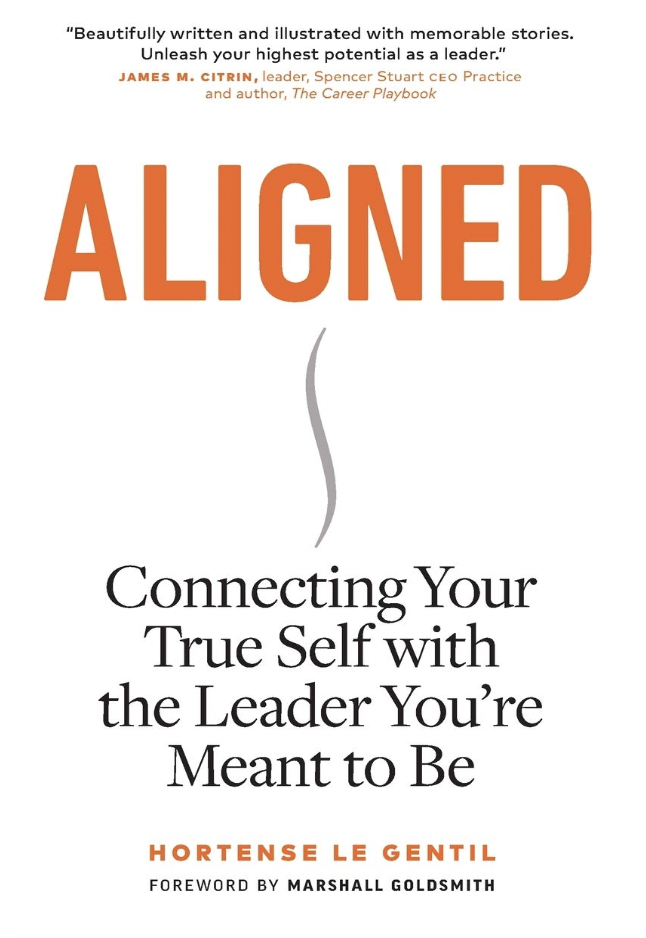
Hortense le Gentil, a leadership coach and consultant, believes that alignment brings you clarity and agility in the face of challenge and setback. This type of inner peace, a “congruence” is achieved through self-recognition, courage, practice, and the ability to project and share yourself so you can help others achieve alignment as well.
What kept coming up throughout the book is the connection of alignment with energy. That connecting with yourself and leading from yourself, produces, maintains, and extends energy.
Across three sections, this book – a fast read – she invites you to 1) meet yourself; 2) meet your potential; and 3) be the leader you can be.
Part 1: Meet Yourself
When you know who you are, you know what to align with.
We have all felt it. That feeling that we are just going through the motions, taking steps towards something and we aren’t quite sure why, or we know why, and we aren’t quite sure how. le Gentil points to this as a central problem: misalignment, because we don’t know how to closer the gap between who we are and what we want. We need a “tune up” – and when we get one, we get that feeling of synergy, focus, determination in the midst of challenge, joy despite setback. She believes you can close this gap with coaching and tools to stay close to who you really are: by finding people who can help you see who you really are, and connect that to what you really want.
How to get there:
- Get clarity on what drives you. Getting rooted in purpose is step one, and you get there by going back to your childhood, your upbringing, and understanding the dreams that shaped who you are. Look back before you look ahead: map your life, and look at the key moments and moves that have shaped you.
Part 2: Meet your Potential
Connect with the best version of the leader already within you.
The best of part two were some practical tools to employ as you build and grow as a leader:
- Learn how to “cultivate positive emotions”: your emotions shape you and the people around you. When you “maintain a positive outlook at the top” this reverberates throughout the entire organization. How to do this?
-
- Remember specific things that brought you joy.
- Notice how you interpret events or conversations, and practice looking for silver linings or positive moments in each one. Choose one good thing, this helps avoid connecting the interaction with a litany of problems or
- Physically smile. She talks about how even just the act of turning your frown upside-down (my words not hers lol) will help you as it will send positive signals to your brain.
- Deal with setbacks “productively”: Accept responsibility: this reduces the anxiety of your team members and signals to others that leaders can fail, and can try again, and they can too. The energy you will feel and gain by stretching and persevering in spite of failure will give you the strength to try again.
- Value your Intuition;
- Beyond just valuing your intuition, she implores us to value intuition in general: it is more powerful than we realize.
- Essentially, intuition is “Sensing” = the ability to just know something, “directly and immediately”.
- Intuition allows us to process and handle complicated situations, don’t discount that. “Scientific experiments have confirmed that while conscious deliberation produces better outcomes for simple choices, complex decisions involving multiple factors are better served by subconscious deliberation.”
- Leaders have to operate with speed and complexity, and we have to learn not just to see things rationally, but to also value and listen to our subconscious, and connect that to our decision making as well. Listen to yourself, and value what that voice says.
- How do you make room for intuition? Take a Break!
- Take a break:
- le Gentil tells us how to take a break: easy – suspend the past and the future. Ok but what that really means is: “stand in the present moment.”
- This simply means, “be present, fully aware of what you are doing – whether you are cooking, listening to music, walking, or staring at the ceiling. All you need to do is focus on something other than your thoughts.”
- When you anchor yourself in the present, you clear your head, and your decisions are actually going to be better and you will become more aligned with yourself.
- Prioritize your energy and attention. HOW? “be clear on where you can have impact – and where you can’t”
- When you focus on what you can change, you get clarity back.
- You know how to spend your time.
- Don’t take your foot off the pedal too soon: keep laser focused on the obstacle and see it through to the finish line.
Part 3: Be the Leader you can Be:
When you have strong inner alignment, you can “translate your vision and thoughts into actions and results, steering your ship with influence.”
This section was short, sweet and powerful. She guides the reader to take all of the work done internally to external audiences, and discusses the power and realities of translating vision to action. She compares this to horse riding, a lifelong passion, remembering a lesson her father taught her: “If your horse is not responding properly, then you’re not communicating effectively.”
Keys to effectively translating vision and internal alignment to external communication:
- “Communication starts with purpose.” And even more than that, a “well-articulated collective purpose.”
- Shared purpose fuels “ a spirit of belonging in the organization,” which translates to “enthusiasm, initiative and productivity.”
- Trust your team, keep people well-informed. This is “crucial when the going gets tough.” She references her friend, Hubert Joly, throughout the book (whose Book, The Heart of Business I reviewed last week) and shares his vision for effective communication during the Best Buy turnaround: “turnarounds are not linear,” he says, “There will be moments of setbacks, failures and doubts” and the hedge you have against that is to communicate clearly and keep people well informed about the what and the how.
- For Le Gentil, you must ask yourself, is everyone clear on the what, they why and the how?
Her most powerful point of the book comes together when she describes what this truly means for you and the people you lead: you let go, and let them lead in strength.
The art of letting go: We go back to the example of horseback riding: when that horse is ready for the jump, you have to trust. You have to let go: you’ve done everything you can to get that horse to the jump, and now they have to do it: “let the horse take off”. “Leaders must increasingly take on the role of facilitators,”
How do you do this? You hire and trust. She talks about Chouinard at Patagonia, who steers “with a very light touch” because he hires people who are closely aligned with the vision and values of the company. His view? “top down management takes a tremendous amount of energy.”
le Gentil has given us a gift in this book. Alignment for her “is not contained but whole,” and it’s a practice. When you take the time to do it, when you recognize when you’re out of it, and when you refocus to regain it, you will be better as will the people you influence and impact.