subscribe to follow along
Mattering
Jennifer Breheny Wallace
I loved this book. Jennifer Breheney Wallace explores the idea of “Mattering” which she describes as “the feeling that we are valued and needed by others.” For Wallace, it’s “that we are valued and have value to add to the world.“ At its core, when you matter, you are assured that your “presence and actions are significant to others.” When you matter, you “feel like an essential piece of the puzzle.” 🧩
For Wallace, mattering is “like gravity: unseen, but essential.” She describes the book and the research to get there as “part pilgrimage part of investigation.”
She explores not just what mattering is, but who matters who feels that they matter and what have they done to get there? At the core, they have built a “ internal infrastructure”. It has become a “practice, a foundation, a way forward.”
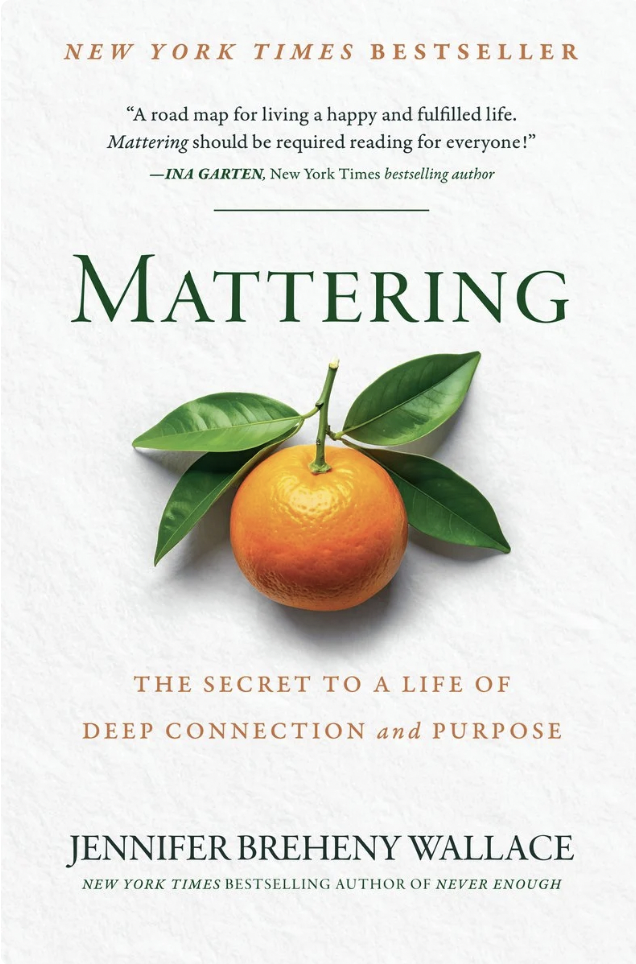
The book shows us that way.
Wallace explores how to foster mattering, for yourself, and for others:
Mattering:
- Stay close to why you matter: “one of the most powerful ways to connect with your input practice is to recognize how you roll no matter how small may seem fits into a larger purpose.”
- “When we were hurting a stretch, thin, the instinct is often to retreat. “Rather you should focus on others even for a few hours a week. Turning your lens outward can be a powerful way to gain energy and feel renewed in your purpose. Wallace is still in here between obligation and responsibility: “where obligation says you have to responsibility says you can.”
There are five components to the mattering core:
- Recognition: connect to your impact. This was my favorite chapter because it connects closely to why I believe so much in the Lead with How framework: we often struggle to see the impact of the work we do, and as Wallace points out: “It’s difficult to stay purposeful if it seems like what you’re doing has no impact on others.” Her advice: notice small things, don’t look for perfect words to give compliments, just give them; keep track of your wins and the ways you add value (my platform to do this easily is coming..!) connect your work to the bigger picture.
- Reliance: Essentially here, Wallace points to the power of being relied on. “Where obligation says “you have to” responsibility says, “you can” – “one feels like weight, while the other feels like an invitation.” Where can you add value? Where can you put yourself in a place where others are relying on you? When you “turn outward” and make a difference, this is the difference maker for you. Her advice here? Think about what you would do for free and reflect on what you are “uniquely positioned to offer.” Ask people for advice (this “affirms their value”), and transform painful parts of your life into ways you can make a difference and add value. Ask what others need (“we create space for others to define what their needs actually are.” Big idea: reliance is a counterweight: it balances you and fills you when you make yourself useful to others.
- Importance: I loved this chapter on the “transformative power of being recognized.” Importance is “the feeling of being significant or valued.” My favorite moment of this chapter was the power of making yourself important to yourself. “It’s also about how we treat ourselves.” We need to “recalibrate our view of ourselves.” She calls this idea radical in most situations, because usually we put ourselves last and deal with all of the other competing priorities. When you prioritize yourself “it’s a declaration of worth and a refusal to always put yourself last.” When other prioritize you this is powerful as well. She shares a story about someone who was prioritized and cared for as feeling “I was being shown the ocean for the first time… I didn’t know that kind of kindness existed in the world.” Her advice? Don’t give to the point of depletion. Take small deliberate actions to show others you prioritize them: “mattering lies in the details.”
- Ego Extension: When we have people in our lives “who are invested in our growth” we are “more likely to feel like we matter.” This chapter is all about the sense of possibility we feel and that we can make others feel when we invest our time and energy in their potential and growth. She tells a poignant story of a sanitation worker whose colleagues worked hard to help him get to and stay in college. “It was the sanitation workers who saw me and lifted me up.” Sometimes we need others to “see and name what we are capable of when we can’t see it ourselves.” Her advice? Invite people in. “Letting other in is how we become stronger and wiser.”
- Attunement: This chapter is essentially about paying attention. “It assures us that someone get us.” It’s a subtle idea with a big impact. She references psychiatrist Dan Siegel who says that attunement is the ability to “resonate with the inner world of another,” and the way you get there is mirroring and reflecting people back to themselves. Attention is one of our most valuable resources. When we tune in, when we show others they are “worthy of a connected response” we build a strong sense of mattering for ourselves and others. Her advice? Tune in to others, tune into yourself, and “broadcast back” – She talks about firefighters who rush to a scene, help everyone there, leave, and never hear the end result. Did their work matter? Their captain whose story she tells here, Greg, worked to find out the outcome of some o the most difficult scenes. Share with others, and yourself, the impact that you have, and tune in to help others receive what they need to feel valued.
In the next sections she talks about transitions, mattering at work, and the importance of why we matter. Some of my favorite ideas:
- When you go through life’s transitions, things change and things that make us feel that we matter can shift and disappear. Watch for this, look out for it, and continue to build layers of mattering in the new spaces and places where you go.
- Vulnerability is linked to trustworthiness: it is not a flaw to show who you really are, rather, a strength. “it’s those imperfect paths of ourselves that create paths to true connection by giving others something real to grasp.
- “Having a direct connection to your impact increases motivation and resilience.”
- Great teams are given “the emotional scaffolding” to do their best work.
- Mattering and proximity: we can be architects of mattering. She references Sam Pressler’s infrastructure framework: “We need to understand where people experience community, how people participate in it, and with whom they form relationships..
Mattering is a powerful idea and what Wallace shows us is that it doesn’t have to be grand and we don’t have to wait. Mattering happens in between spaces, meetings, in conversations and those all build up across our lives. She quotes Desmond Tutu which I think is a powerful way to end this review:
Do your little big of good where you are: it’s those little bits of good put together that overwhelm the world.