subscribe to follow along
range
David Epstein
If you were ever unsure about what to be when you grow up, know someone who is, or are in a moment of change/growth/learning (aren’t we all!) be not dismayed nor discouraged: you, my friend, can build toward – and probably already possess – Range.
“Our greatest strength is the exact opposite of narrow specialization. It is the ability to integrate broadly.”
David Epstein shows us – from Kepler (a lifetime of discoveries built on analogical thinking) to Eastman (“each experience comes with a lesson”) to Tu Youyou (Nobel Prize! Made one of the most “profound discoveries in medicine” by reading a fourth-century Chinese alchemist – artemisinin!) – that lateral, cross-domain, outside the box thinking, is powerful. “Take your skills and apply them to a new problem.”
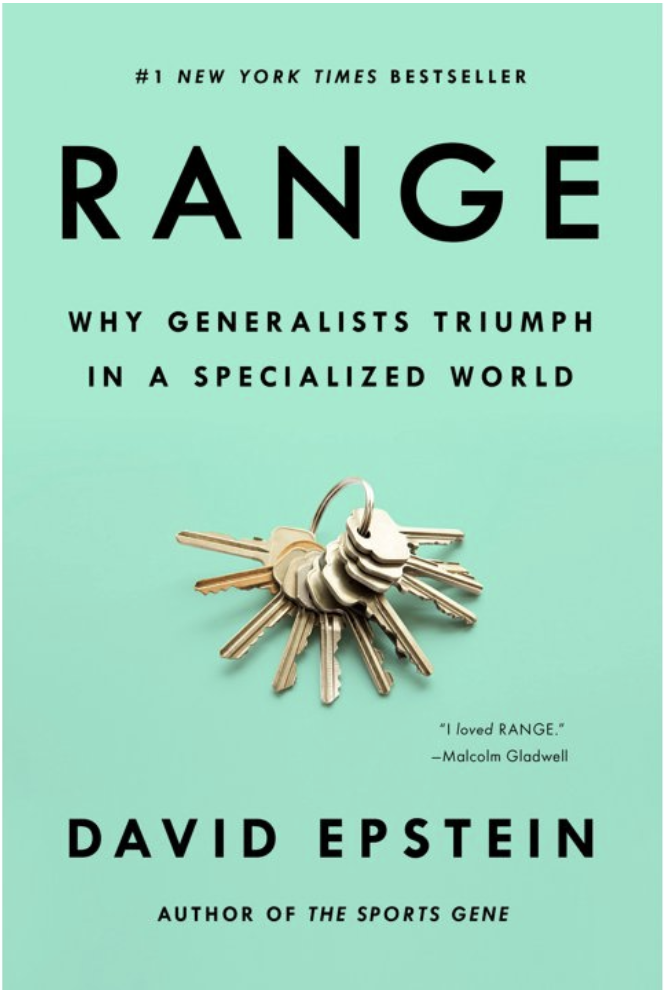
Range begins with an assurance: you don’t need to be Tiger Woods, golf club in hand at two years old. In fact, hyper specialization can lead to inflexible thinking.
For Epstein, Range is a life hack. If you’ve made a mid-career change, or are thinking about it, he suggest you will be successful because you will bring brad thinking, you will see patterns differently, you will interrupt inclination toward previous solutions.
Key concepts I loved:
- Prioritize interdisciplinary thinking. Have a wide range of interests and pursue them with alacrity.
- Don’t just think about what you are studying, think about how you do it (you know I love to think about how!). Take math for example: it can’t simply be procedural practice. Math, however, is a system. Studies show that students with broad conceptual reasoning, who have friction as they study (“desirable difficulties”), do not show immediate performance, but their subsequent and long-term learning is enhanced. He even shows how powerful it is to work at and get a wrong answer “big mistakes can create the best learning opportunities.” He encourages teachers to wait: listen, don’t hint. Struggle produces long-term learning. Struggle = achievement.
- The power of analogical thinking. We explore Kepler, the inventor of astrophysics. “Analogies were all he had.” Epstein shows us that his ability to “think entirely outside the domain” allowed him to understand planetary motion. He would watch boatmen in a swirling river and surmised circular planetary currents. He studied magnets, and thought about poles and attraction keeping patents moving forward in orbits. “We need to be able to pick a strategy for problems we have never seen before.” Analogical thinking studies shows the power of this type of creative thinking: a “single analogy from a different domain tripled the proportion of solvers.” Taking an “outside view” means that you see experience, new connections, reading widely, as a gift: “a mind kept wide open will take something new from every experience.”
- We learn as we go. “We learn who we are in practice, not in theory… by living, and not before.” As Michealangelo love Ibarra’s aphorism:” I know who I am when I see what I do.” So take the step. Try a new course. Apply your degree, whatever it is or was, to new problems: “knowledge pockets” are often “hidden under other degrees.”
- Problems can be solved by a diverse array of people from a variety of backgrounds. He talks about InnoCentive, which posts challenges and rewards outside solvers. ‘Outside-In’ thinking”. The problems were solved at a greater frequency by those who brought solutions from across domains: “the further the problem was from the solver’s expertise, the more likely they were to solve it.”
- Lateral thinking applies to technology as well. We learn the history of Nintendo – a small shop in Kyoto where a electronics graduate, Gunpei Yokoi, worked and tinkered “with withered technology” reimagining new usage for old parts and equipment. After watching a weary traveler playing on his calculator on the commute home, he was inspired. He would eventually produce the Game Boy “the Sony Walkman of video gaming” that eschewed new bright screens and top of the line animation for simplicity, portability and affordability – selling 118.7 million units. Epstein shows the Range principle applied here: “alternate uses for new technology” is a way to empower innovation and find broader and deeper uses for something we have lying around. Innovators push knowledge, can handle ambiguity, and can bring “technical knowledge from peripheral domains.”
For Epstien, innovation alters the equation. And innovation and human ingenuity is grounded in a life built on “collecting perspectives,” on seeing the “simplicity beneath the complexity,” and sometimes, on casting aside experience entirely.
How do we get there? Try to be new at something. He points that the word amateur “did not originate as an insult, but comes from the Latin word for a person who enjoys a particular endeavor.” Wander. Pretend that you have just begun. Discoveries are often “triggered by unpredictable and unforeseen small findings.”
He isn’t calling for an end of vocation or specializing (we certainly want our doctors and lawyers et cetera to know what they are up to!) but rather to recognize the power of thinking, learning and expanding across disciplines, of supporting a variety of pathways across life. He seeks to remove the pressure of getting a head start. While they can be powerful (Tiger example!) they are not the only way. Even Tiger’s father admits it wasn’t that the club was placed in his hand, it’s that he reached for it. A child’s desire to play. Mozart as well. He begged to try the violin, and played it before he had even had a less. He had “rage to master”.
The better, more full, more beautiful path, may meander. It may lead in several directions. As parents, Epstein that the best strategy may be “exposing children to an array of activities and seeing if one happens to light their fire.”
So learn, grow, build, explore, think broadly, and seek to be new at something. This is the way to build a life of Range.