subscribe to follow along
the heart of business
by hubert joly
I loved this book. It could have been named “From Profit to Purpose.” Hubert Joly builds a vision for human centered leadership and organizational culture that focuses on connection as the core vision for capitalism. He sees leadership as a journey of both personal and organizational vulnerability. For Joly, purpose, and human and social connection, is at the heart of business. He articulates the way he discovered this core across his work leading companies in France and the US, most notably, turning around Best Buy.
He builds his case by first outlining the reason for work itself: not only an essential element of humanity, but the opportunity to be fulfilled while doing good things for others.
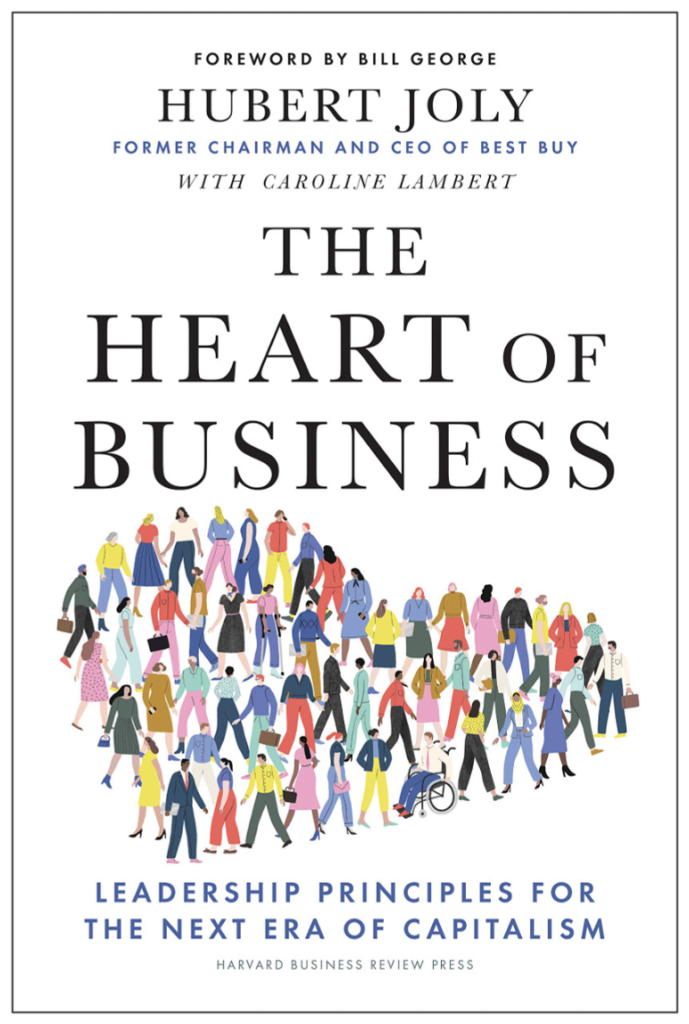
He encourages us to consider how our work is connected to purpose. Rather than work as a quest for perfection, we relate and bond through our imperfection, and as leaders we must have the “courage to be imperfect” and embrace vulnerability. Work then, becomes a “quest for meaning.”
He centers his discussions on three key areas: organizations, unleashing human magic, and purposeful leadership.
Organizations and their core goals:
Organizations must put people at the center: people are “a company’s most important aspect” and he posits that employees were the engine of Best Buy’s successful turnaround.
When you link purpose with strategy you enrich lives. For Best Buy, that purpose was “enriching lives through technology” and this focus fundamentally changed how they did business. Their turnaround was a story of spending time focusing on people. Their employees, and their customers. He talks later in the book that people thought he was crazy to take on the role leading Best Buy. Most saw it as a lost cause. Joly saw it as a challenge that would give him energy and a chance to orient people around a common goal and solve a puzzle together.
They became expansive in the way they carried out this purpose. He brings up Best Buys’ Geek Squad: they will help you with tech trouble even if you didn’t buy your device at Best Buy. When you put people at the center, Joly argues, it pays off. Another example is their store-within-a-store idea. They tried it first with Samsung. They added Google, Apple and others. This was great for customers, and, it turned out, drove traffic to the stores. Additionally, rather than seeing Amazon as a threat, they dedicated space to their products. It was good for customers, and it ended up being good for Best Buy. Partnerships, it turns out, was the key to their survival.
It wasn’t always this way. When he first arrived, he spent time walking the stores. Learning and watching and listening. He realized that they had to “start from within.” A helpful question he considered among his teams: “If Best Buy were a person, how would she or he behave?” They gathered teams and people who knew the company best and went on this journey. “Our plan was not perfect, but it was good enough.”
Joly worked to sustain and build the turnaround through momentum and energy by creating “a sense of possibility and hope.” He spent time clarifying what was important while keeping things simple, which unleashed incredible energy across the organization. “We were on a mission together, and the energy was electrifying.”
He took major stock of the problems – “you cannot solve problems if you do not know what they are” – and leveraged and encouraged people to rally around these problems by building purpose and focus.
Unleashing Human Magic
Form there, Joly tuns to his idea of “unleashing human magic.” People “are a source, not a resource.” The way you gather, inspire and unleash people is through strong communication: articulating your views “early and often” so that they “take root” and grow across the organization. This creates “fertile ground for everyone to flourish.”
One way to unleash is through storytelling, which “fosters a sense of purpose and connection with where we work and whom we work with.” The Best Buy team, the “Blue Shirts,” were key to this. He spent time learning and telling their stories across the organization. By doing this, he “connects purpose to practice.” This allows him to take these stores and “translate” them into daily behaviors across the company.” Stories remind everyone of purpose.
This is the core of my framework, Lead with How. That you have to show, clearly, early, and often, how stories connect your mission (what you do) to your vision (why you do it) and that articulating these stories as often as possible gives nuance and clarity to exactly how all the work you are doing connects and builds together to achieve impact and provide value, as well as achieve, in all or sum, the vision you are collectively working toward.
When you lead with how, you create and cultivate the conditions for everyone to feel invested in and connected to purpose.
Story is the how: it is how you build and create connection across the organization and across the community. When you tell stores, you “make people feel that they are big” by highlighting and recognizing their work. When you remember names, when you remember kindness, when you acknowledge, you build a flywheel of purpose and connection to vision.
When you recognize people, you also value people, and that was central to Joly because he saw them as the key to success at Best Buy and across his career. People know the answers when they are asked, they will come up with brilliance. “Decision should be made at the lowest possible echelon within the organization” which is the place where people have “either enough or the best information” to make the best choices and decisions.
Connecting all of this to vision is incredibly powerful. At Best Buy, they worked as a leadership team to “open a world of possibilities.” Vision is the purpose that serves as “a horizon line you never reach.”
A Call for Purposeful Leadership
Finally, Joly calls for purposeful leadership. He debunks four leadership myths, shared here with their key ideas:
- Myth 1: Leaders are superheroes. Not the case. “My goal from the very start was to be dispensable.” While I think visibility is very closely linked to growth, impact, and the ability to build, I agree that it can’t be visibility for its own sake. It must highlight the work of the wider team. I do however, think that leaders should be visible. He has written a book to make his ideas visible, it’s just that you can’t do so at the expense of relationships.
- Myth 2: People are born leaders. You can become.
- Myth 3: You cannot change. Create an environment where others can grow and flourish.
Leadership, he argues, is about “unwavering commitment” with a central role of creating energy and momentum “to help others see possibilities and potential.”
Some key ideas and quotes from the above sections that I loved:
- Instead of feedback: feedforward – choose areas you want to work on; don’t focus on fixing a problem you have, rather, decide what you want to get better at.
- Innovation at tech companies “slow by 40 percent after IPOs because management becomes more cautious once they are subject to market pressures.”
- Sometimes tech feels like “fast fashion” there is “forced obsolesce” as they push out products and stop supporting older products.
- Profit is an outcome, not a purpose.
- Profit is an “outcome of successful strategy and the quality of the human relationships that drive it.” And while profit is an outcome, it is “also an imperative.”
- Businesses need “thriving communities to flourish” and employees are “central to that connection.”
- Purpose for companies pushes them to “be the best version of itself, rather than being better than someone else.” Reframe your objective in light of your great purpose. An example here: Ralph Lauren. Their purpose is “inspiring the dream of a better life through authenticity and timeless style.” It’s not a clothing company, rather, it’s a lifestyle business. This is a “much more positive perspective: instead of obsessing about crushing the competition” you need to be guided by your own purpose and seek to be the best version of yourself.
- “Collective action creates greater impact faster.” He goes on: “It is in our vulnerability that we connect and unlock the power of the collective,” and “humanity is what binds personal to collective purpose.” When you work to create high performing teams, the “best version of every individual must translate to the best version of the collective.”
- “Value creates value.”
I found this book incredibly helpful around getting to the core of what matters. He is best in his chapter “On Building Cathedrals” around pursuing purpose over profits and that in doing so, the business will grow.
It is a powerful read because Joly learned all of these lessons over a long lifetime at McKenzie, Medtronic, and many other companies, but it all came to the fore at Best Buy, as he took on a company that needed him to summon all these lessons and more to turn around, and do it quickly.
He was able to take his heart for people, relationships, and connections, and see if it could meet the moment at Best Buy. All of this sounds beautiful – heart, empathy, love and connection – but can it work in stress, in real-time? The answer is yes. He did it. He took on the company when it was in dire straits in 2012, and he passed the baton in 2019, leaving behind a robust business: six years of growth; earnings that had tripled; and the media calling it a turnaround that “defied expectations”.
In his first few first days leading the company, Joly walked the floors and wore a badge that said “CEO in Training.” He spent time learning and built the promise of growth and change around a tagline: “Renew Blue” (employees wear blue shirts) – focusing the work on renewing the team for the good of the company and customer.
By focusing on purpose, he built profits. By focusing on people, he rebuilt a company. From his first moments as CEO to his final days, he is telling us the story in his own words: I’m not a hero, rather, someone who elevated what everyone thought was possible. He lifted and grew the heart of business: connection, inspiration, engagement and energy.