subscribe to follow along
the yellow pad
by robert e. rubin
Robert Rubin writes this book as an acknowledgement to those who have shaped his life: President Clinton, Gus Levy and more, people who he led alongside in his career in finance and government, reflecting not just on the moments, but the ways he made decisions that shaped the lives of thousands – millions – of people. From his work at the Treasury, to the White House, to his time at Goldman and Citi, he recognizes that “everything is uncertain” and seeks to explain how he thinks about thinking and how to make decisions when the stakes are high.
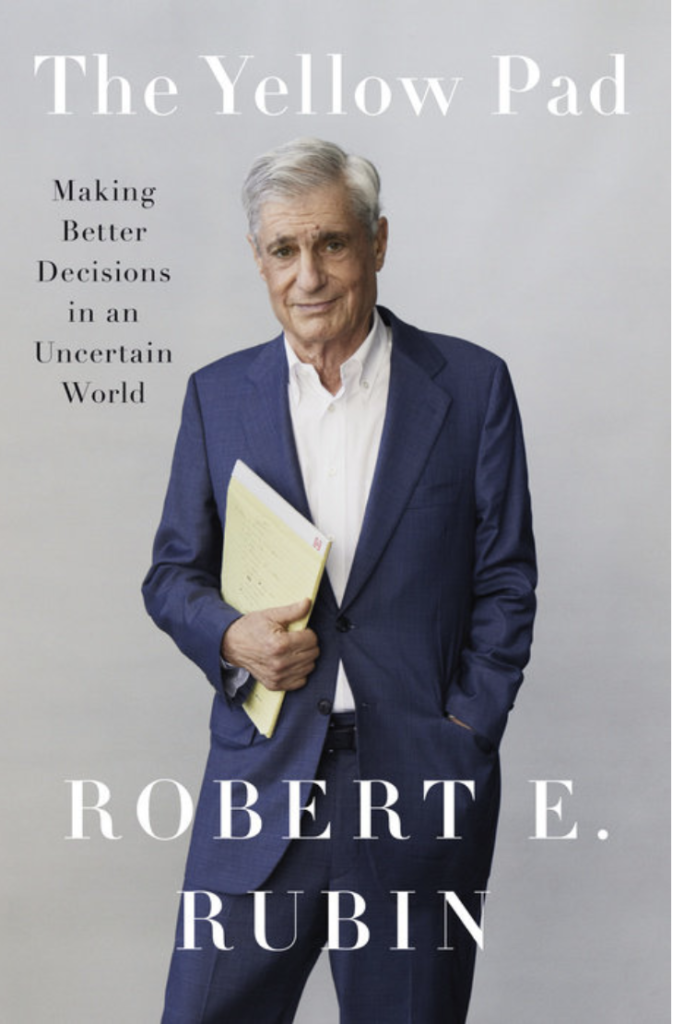
He looks back at Philosophy 101, his most formative class at Harvard, taught by Raphael Demos. From this class he built an effective intellectual framework to engage in and make choices to address challenges. He believes that anyone who grapples with complexity can do the sane. The Yellow Pad is his way of talking about probabilistic thinking: drawing conclusions by understanding and viewing problems in terms of probabilities: split that yellow pad down the middle and weigh your options. It is his personal philosophy of decision-making, allowing him to weigh different courses of actions and potential outcomes through a simple tool that he used frequently to attack complexity.
He explores his political thinking and weighs in on the issues he cares about and his own democratic ideals.
What I found most powerful were the lessons learned at some of his most crucial moments of decision, and I’ll share those here:
- Don’t make emotional decisions at moments of extreme disruption, rather “build that discipline before a moment of disruption strikes.” Understand your emotional biases “and compensate for them.”
- Embrace different viewpoints as essential to understanding.
- A “yellow-pad approach to risk is not just helpful” but is actually the “only way to adequately handle the uncertainty of a changing and complex world.”
- “We are all three people: how others see us, how we see ourselves, and who we really are.”
- On traits that have shaped his life and career:
- “it’s about accomplishing whatever I’m engaged in.”
- Mental toughness: “people who make decisions that have large consequences must be able to weather the ups and downs of life.” Mental toughness takes time to build. Larry Summers with whom he worked closely, would discuss mental toughness in terms of basketball. Players have to have an “irrational sense of optimism: if the last shot didn’t go in, they still believe in the next one.”
- Leaders “acknowledge the distinct possibility of failure” and “do not dwell on things that go wrong,” and “don’t get too carried away when things go well.”
- The ability to “get things done” – leaders have the ability to turn ideas into reality. They are able to “shepherd those ideas in ways that others can not”
- Energetic Curiosity: they look under the hood, they don’t assume anything, they are active (rather than passive) and they are “interested in an enormous range of things.”
- A basic disposition to be true to oneself. The challenge, Rubin admits, is “how to maintain one’s sense of self, intellectual integrity, and independence while still being part of something larger.”
- “Give and take is not about finding common ground, it’s about moving forward in the absence of common ground.”
- One way to make a decision is called, “preserving optionality” – think, “do I have to make this decision right now?” if not, figure out what you need to do in order to make a better decision later.
His thoughts on the economy:
- “An important goal of economic policy should be to reduce the role of luck and to increase the role of talent, personal qualities, and hard work in determining one’s odds of success.”
His thoughts on management:
- Success at a job does not always translate to success at managing others
- Every individual is unique and you must embrace “human complexity” in decision-making.
- It’s important for managers “to be supportive when someone they are managing makes a mistake, especially if that person is feeling anxiety about having made it.”
- “You work for the people who work for you.”
- “Ask questions rather than make statements.”
- “Walk the floor” – it is important to get out of your office and engage with people.
Lessons from President Clinton and his time at the White House:
- “He would focus on the quality of the advice and ideas and not who offered them.”
- Regarding Larry Summers: “he encourage
Lessons for organizational leadership and culture:
- Steve Friedman calls strong organizational culture: “strategic dynamism” which is where you “create an environment in which long-term strategy shift and adapt, but core values and principles remain constant.” This type of anchoring ensuring organizations make decisions that are true to themselves.
- “Culture is both a means to an end and an end in itself”
“Be long-term selfish”
- Where I found Rubin the most powerful, was in his discussion of taking the long view. He was at Citi when they were caught up in the 2008 financial crisis and recognized that their culture very much was oriented to short term gains rather than long-term vision. He uses the phrase from his boss at Goldman, Gus Levy, who would always say: “be long-term selfish”. Your relationships are for the long-term. Give clients the best advice, waive fees if needed, build partnerships that are better for them and produce lasting value. We all face pressure to produce value, to perform this quarter. We prioritize and overemphasize the short-term but instead we need to focus on maximizing value over time.
- Think: not only, what is the best decision, but “over what length of time?”
For me I think that there is so much power in showing immediate impact, but connecting that to data that shows a longer-term value horizon. This is the core of my Lead with How framework that looks at how to build tension and connection between short term impact and long-term value.
Rubin’s extraordinary life, his political and social impulses, his key concerns and the moments that shaped him are all there for anyone wishing to understand his thinking from his first philosophy class at Harvard to the challenges he faced making the best decisions on his Yellow Legal pad. Essentially he is sharing with us that it is possible to not just think, but to think about your thinking, and create patterns and systems that allow you to weigh, stand back and evaluate the best outcomes for the most people to experience success.