Give and Take
by Adam Grant
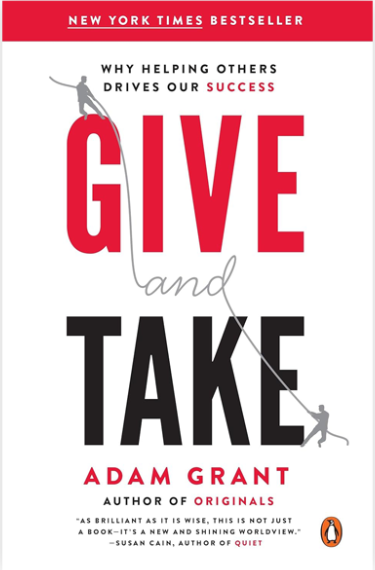
Give and Take by Adam Grant is the book I have referenced and referred to the most over the past year. I love it. Grant’s major premise that carries through brilliant examples, stories and experiences is the distinctive idea that when “givers” succeed, a positive ripple effect carries forward to all: their success “spreads and cascades.”
A “giver” (as opposed to a taker or a receiver) is someone who acts for the greater good, builds success through teamwork and service, operates in an interdependent way, and works to shape a world that is better for everyone. This person shares their network willingly, volunteers their time, gives credit to others, and creates an environment where everyone can contribute – and, Grant argues, this doesn’t hold them back, rather, it propels them forward in a unique way. For Grant, you can be a giver, and be successful. In fact, you will be more successful.
- The five-minute favor shared via Adam Rifkin: “You should be willing to do something that will take you five minutes or less for anybody.”
- Networks are a vehicle for “creating value for everyone, not just claiming it for ourselves.”
- Expanding the Pie: when you share, give, extend yourself, the pieces of the pie don’t get smaller, the pie gets bigger (!).
- Givers succeed by recognizing potential in others
- Successful givers are also self-interested. This is the idea of operating as “otherish” that Grant introduces in my favorite chapter, 6, called “The Art of Motivation Maintenance.” He shares: “you care about benefitting others, but you also have ambitious goals.” You give, but you are careful not to overextend. You balance concern for others and concern for self. Burnout, compassion fatigue, whatever you might call it, is something givers are vulnerable to. It’s a loss of energy. By finding ways to give that are energizing rather than exhausting, Grant suggests increasing the amount of feedback you are getting about your giving, and recommends that you “outsource inspiration to others” by learning and leaning into the stories of impact that people have experienced because of your work. This is powerful to think about in my role leading a nonprofit: consistently keep story and impact as the north star for our team, volunteers and partners. For me, that means clearly communicating the effect our community makes on our teachers, kids and schools, in order to renew our energy to carry out our mission to achieve our vision.