think like a horse
by grant golliher
I was in Jackson Hole, one of the most amazing, beautiful places on planet earth, and walked into my favorite bookstore, Valley Books, and saw it on display: “Think Like a Horse” by Grant Golliher, the owner of Diamond Cross Ranch. The subtitle said it all: Lessons in Life, Leadership and Empathy from an Unconventional Cowboy. You had me at leadership! And at the picture of Golliher riding his horse through a beautiful Montana meadow.
A maxim for life: when in Jackson Hole, you buy the leadership book written by a real life cowboy.
And it was great. I loved it, and I learned a lot. The best line from the book is something I can’t bury in this review, so we have to start with it: “When you lose, don’t lose the lesson.”
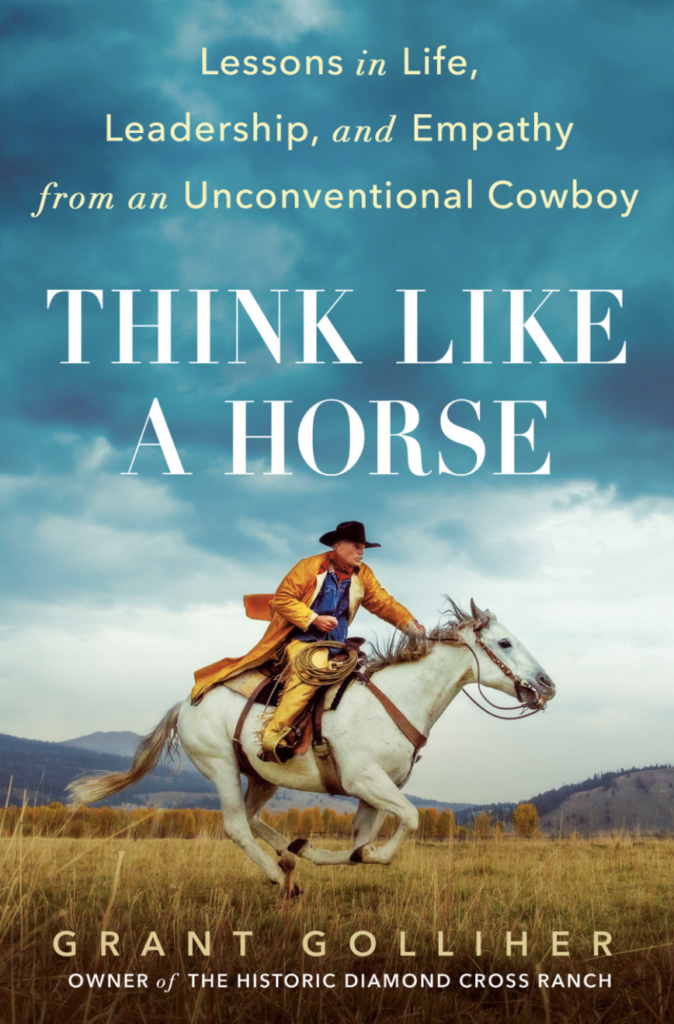
Golliher is honest about his losses, transparent about his wins, and vulnerable and open in all the best ways. He opens up himself, his ranch, and his horses, so that we can all learn from their beauty and example.
Diamond Cross Ranch is in Jackson, I drove by it this winter. Beautiful land overlooking the Tetons and beyond. He grew up surrounded by horses, and says of landing in Jackson Hole, “I’m the lucky cowboy that showed up and married the rancher’s daughter.”
Together, they have grown the ranch into a place where people don’t just care for horses, but the horses care for people, teaching some of the world’s greatest leaders, teams and organizations through lessons that extend to all aspects of life.
For Gohllier, his moment of change was when he “began having conversations” with his horses. After being around cowboys who were full of force and fear, he began listening again. He saw that when you move from coercion to choice, when you allowed the horse to exercise free will, you build a “willing partnership.” In other words: when you “think like a horse” you unleash magic.
He became “student of the horse” and the more he listened the more he saw how much horses could teach us all, and found his life’s calling. In his words, “horses do the teaching, I just try to translate.”
What he uncovers ever day, is that “horses have an extraordinary ability to reveal people to themselves” and they “become a powerful catalyst for personal growth and leadership development.”
From executives at Microsoft, to CEO groups, to families and beyond, Diamond Cross Ranch became a place where many people could learn and listen to horses. Here’s what they teach us:
On failure:
- “If he’s turning, he’s learning” – when horses feel fear, they turn away from objects that they’re nervous to approach. Help them keep working at facing their fear.
- When horses make mistakes, you don’t respond with punishment, you keep them moving their feet, moving forward. To help them learn focus on “making the right thing easy and the wrong thing difficult.”
- When people make mistakes, we can respond in the same way: “failure just means you figured out what doesn’t work,” it’s “part of the journey.” As long as the horse (people!) are willing to move their feet, they’re heading in the right direction. If you’re turning, you’re learning!
- Failure isn’t final: “honor the slightest change and the smallest try.”
- “There’s little growth in the comfort zone and little comfort in the growth zone.”
On Pressure
- Pressure Uncovers Purpose: “under pressure, we learn who we are” – he tells the story of Micah, a veteran who felt lost coming home: “When I was deployed, I just wanted to be home, but when I was home, I wanted go back out there.” Diagnosed with PTSD, feeling lost, he started Heroes and Horses: “sometimes the only way that you can find your own way, is by helping somebody else find theirs.” Horses helped him find his way, and they help so many others: horses never lie, they “sense the person’s true intentions”. Part of the program, Golliher explains, is a 41-day intensive skills training: it’s high pressure, but that’s the point. Micah explains about the difficulty and challenge of the program: “struggle gives things value,” it reconnects people with a sense of purpose.
On building a culture of freedom:
- “Freedom of choice is foundational when working with a young horse.”
- Leaders often think the shortest route to the outcome they want is not giving choice. “Treating someone like a partner means giving them a choice and trusting them to make good decisions.” This doesn’t mean a free-for-all, this means setting people up for success “by creating a learning environment where expectations and boundaries are clear but there is freedom within those parameters.”
On the power of our words:
- Names matter. When you name a horse, it represents the potential you see in the horse: “names carry expectations.” The words we use to describe people and horses reveal what we believe. “When it comes to kids and horses, words have power. Actions follow attitudes… words go straight to your soul.. we create worlds with our words.” When you speak well, when you affirm, when you build people up with your words, people often live up to those expectations.
On trust:
- Taking the time to build trust with a horse is foundational. “All of our good intentions will not get us far if we don’t have the patience to build trust” and trust takes groundwork. Trust must be earned with both horses and humans.
- “Trust takes time.”
- “Trust is not just a feeling. It’s also an action, and it’s a process that happens over time.”
On building strong teams:
- “Training a horse is like building a house.” You brick in the foundation every day. You work with a young horse every day, consistently, to lay a foundation, because “a horse will always go back to her foundation when she’s under pressure – you’ll see what she’s made of.” It’s harder to fix them later.
- Helping people build strong foundations isn’t just about today, it’s about the rest of their life.
On being yourself:
- When working a horse, you “work both sides equally.” It’s the same with people: we have sides we don’t want the world to see. But “it can be hard work holding up an image and burying other parts of who you are. If you go through life hiding one side of yourself from the world, it can lead to feeling like nobody really knows who you are.”
- Leaders we trust are those “who seem most able to be themselves – to be honest, humble, and transparent” in public and private.
- There is power in being authentic. “A pedestal is not a safe place to be – when you’re balanced up there trying to save face, it’s easy to take a tumble. You’re much better off with your boots on the solid ground of honest and transparency.”
- Don’t hide weakness or fear: be vulnerable, share mistakes.
- “People prefer leaders with flaws.”
- “Servant leadership is putting yourself into service to others to create the environment where they can be natural and be authentic and allow them to discover that beautiful genius that lives inside them.”
They say that a “cowboy is a man with guts and a horse.” Golliher` has guts, a horse, and a strong leadership development platform that has implications for people at every age and stage. I loved this book.