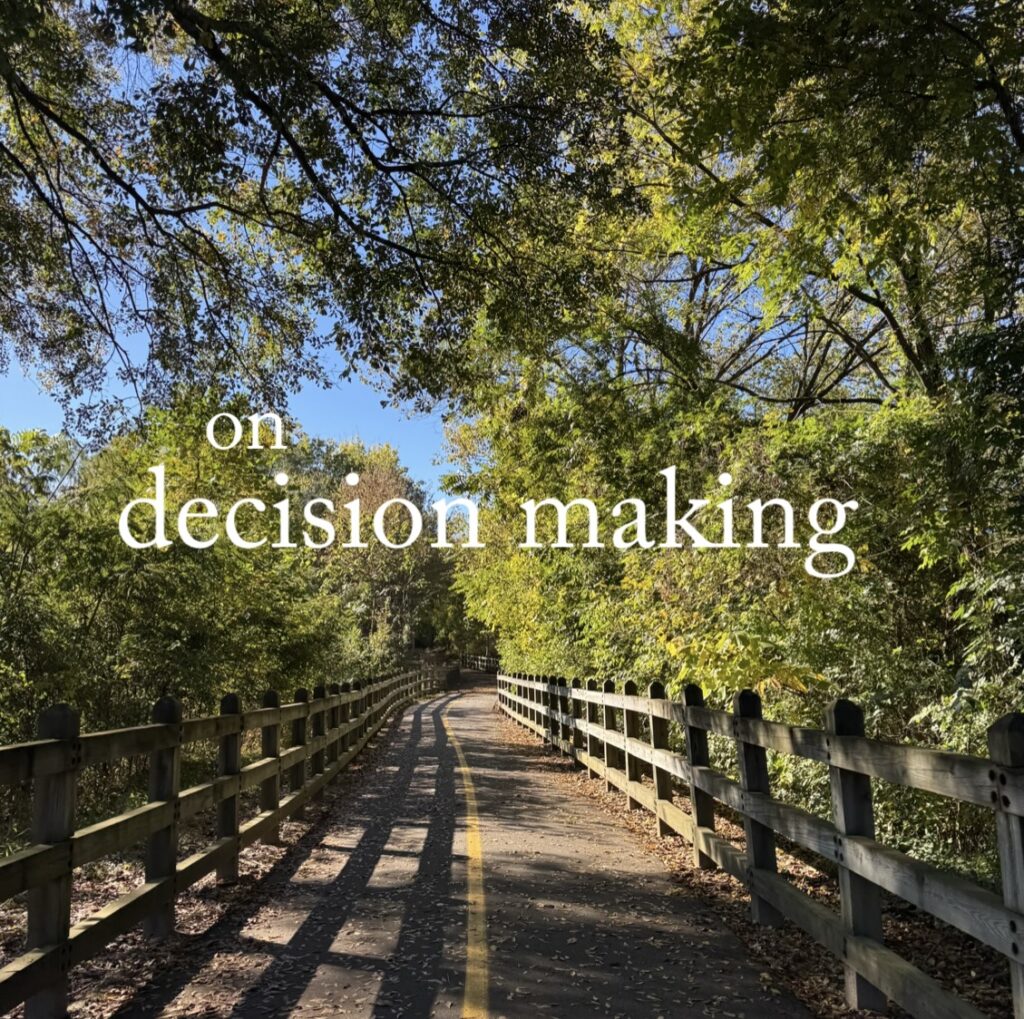
In 2019, Joshua Rothman wrote a brilliant article in the New Yorker, The Art of Decision Making, arguing that decision making, “the craft of making far sighted choices,” is an underappreciated skill.
The paradox of life, argues Rothman, is that our big picture decisions are often “less calculated than our small ones are.” Do we decide or simply move to a new sense of ourselves? Are we in charge of the way we change?
Two ideas are essential here: first, he asks a powerful question: do we really make some of the biggest decisions of our lives? Or do we simply transition to a moment where we can imagine ourselves living in a new way or being someone new. The example used is decision to become a parent: do you decide? Or do you begin to imagine yourself with them?
Second, philosopher Agnes Callard deepens this idea: “To aspire,” she writes, “is to judge one’s present-day self by the standards of a future self who doesn’t yet exist.” When you make a big decision, you simply do not know who you will be on the other side. You can only move toward this new version of yourself.
What I loved most about Rothman’s reflection was that he wants to make us writers rather than readers of our own existence. Maybe part of decisions is aspiring to be somebody or be something new. Writing a new story, changing what we aspire to be, want to want certain things.
In her 2014 book, “Transformative Experience,” Callard she suggests that living “authentically” requires occasionally leaving your old self behind “to create and discover a new self.” Part of being alive is awaiting the “revelation” of “who you’ll become.”
Often in decisions, we have a multi-dimensional matrix we must try to understand how we will feel about these decisions in the near term and the long-term.
I think this leaves us a lot of hope! You can’t and won’t always have the full picture, but you must move forward. Rothman points out: even bad reasons for moving forward are a good placeholder for the good reasons. Everyone goes to college to “become educated, but until I am educated I do not really know what an education is or why it is important.”
We’ve explored decisions from a philosophical lens. How do business leaders approach them?
- For Elena Botelho, CEO at ghSMART, speed is crucial: the velocity of the decision making sets the pace for the organization set direction. Leaders set the direction, and ensure alignment behind it.
- In a 2016 letter to shareholders, Jeff Bezos writes that he typically only has 70% of the information anytime he makes a decision. When you embrace error and course correction, you cultivate a culture of ingenuity and innovation across your team or organization.
- Chris Kempczinski says, “You want he decisions to be made in your organization by the people who have the most information.” Push authority to where knowledge lives.
- Warren Buffett closely ties decisions to thinking time: “I insist on a lot of time being spent thinking, almost every day, just to sit and think. That is very uncommon in American business. I read and think. So I do more reading and thinking, and make less impulse decisions than most people in business. I do it because I like this kind of life.”
- Hubert Joly, in The Heart of Business, writes: “The most important decision we make as leaders, who do we put in positions of power? What matters even more, is the character. What drives this person. What is their purpose in life?”
I don’t think we can escape the reality that in life, business, and everywhere in between, decision making often leaves us feeling conflicted. But I think that tension is a crucial part of the process.
I think it is powerful to cultivate that internal conflict. Pay attention to conflicting feelings as you decide, pray, seek council and think about next steps. Do not try to bury those feelings, but really look at them as an opportunity to get more informed and make a better choices.
Because as we’ve learned, you can never fully know who you will become or what you will learn on the other side of a decision. But taking those first steps of becoming, even without certainty, moves you toward places you could never have imagined.