This week the theme that came up again and again – perhaps because I was reading Range – was about flexible thinking. Exploring outside your domain. Solving problems by looking at them with fresh eyes, bringing new perspectives from a cross section of disciplines.
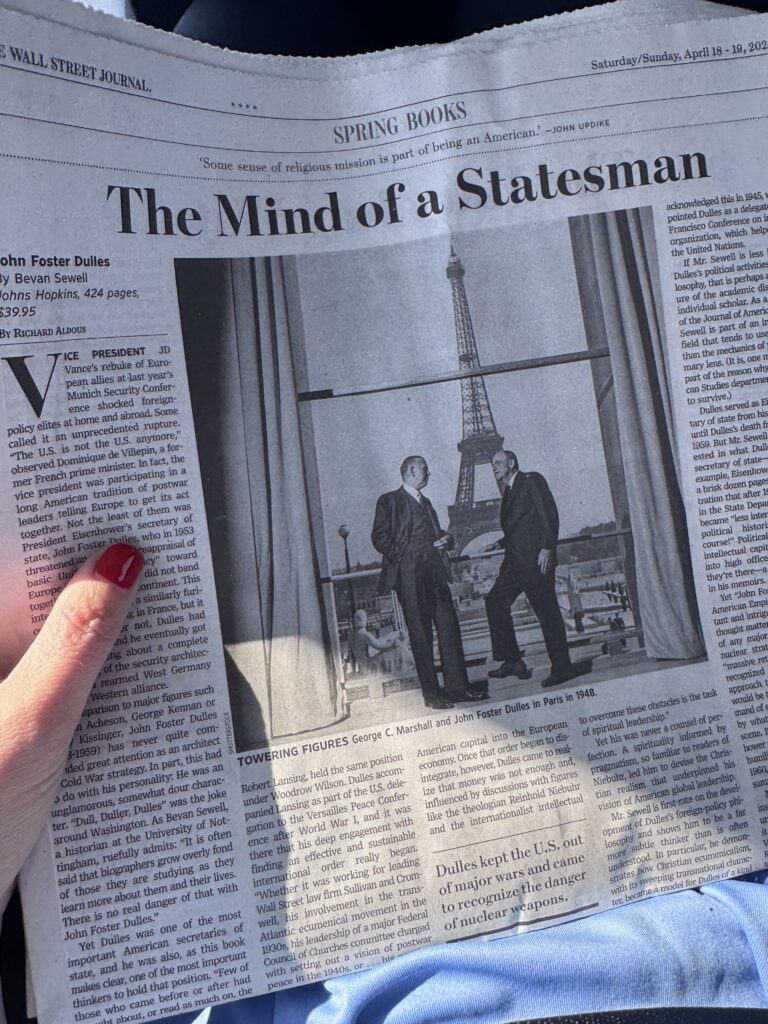
In the WSJ the other week, Sue Brooke highlights in The Mind of a Statesman, the new biography John Foster Dulles: Apostle of American Empire, by Bevan Sewell, which explores the incredible career especially the post war era at John Foster Dallas, who he calls “one of the most important American secretaries of state” as well as “one of the most important thinkers in that position.”
What made him such a great thinker? Flexibility..!! “He was a flexible thinker whose approach shifted over time.”
And it had a lot of time to shift. His childhood was characterized by exposure international affairs because his father was Secretary of State under Benjamin Harrison and his uncle under Woodrow Wilson. He actually attended with his uncle the Versailles peace conference after World War I.
He worked with a goal to shape up a “viable world order.” His faith increasingly was shaped by faith. He began to been that ecumenism was the future and missing link – “moral architecture for the global system.” The leadership required, for Dulles, was spiritual leadership. He built out a type of “political ecumenicalism.”
So how do we build this type of thinking? One idea is called “elastic thinking” and it pertains to not just how we think, but how our thinking applies to and shapes new ideas and opportunities: “logical thought can determine how to drive from your home to the grocery store most efficiently, but it’s elastic thought that gave us the automobile.”
So what is to be done? How can we develop this kind of flexibility? Gareth Cook explores this idea and recommend cultivating insight by “adjusting one’s external conditions.” Expanding perspective and changing horizons – even physically – leads to new pathways for you to think and build intellectual capacity as you solve problems or create new ones (lol).
And don’t just go to a new place. Give yourself some time there. Thinking without time pressure is “important when striving for insight.” So turn off the phone. Find some water or something to stare at, and spend some time in your internal world.
Back to Dulles. There is a lot of power in building in a life of thinking critically, even when things get busy. Don’t fall into the Kissinger pit of doom (but I guess if you’re at his level you’ll be excused: “Political leaders accumulate intellectual capital before they come into high office and spend it once they’re there.” If you’re in a space where you are too busy to accumulate capital, you’re spending, that’s ok. But try not to stay there forever. Spend some time staring into the distance at least. Read my blog (lol). Do a little thinking and stay flexible!