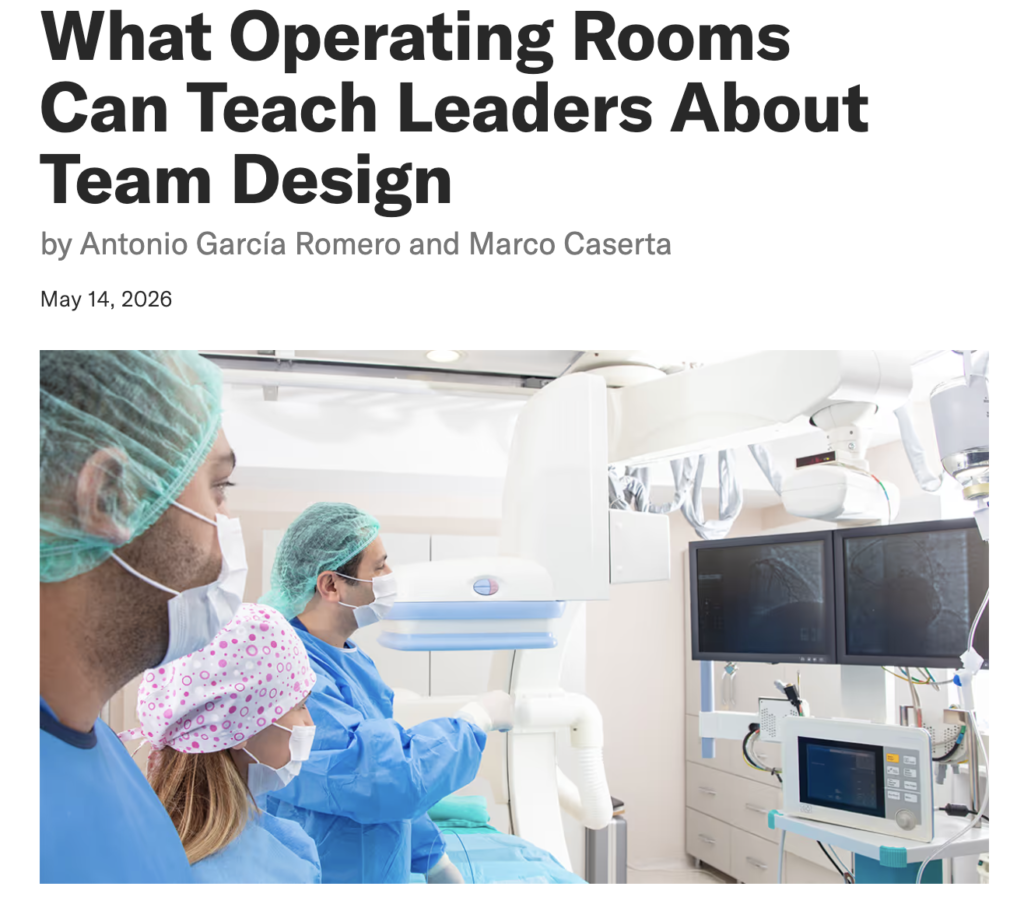
This week I read a brilliant article on thoughtful team design based off learnings the authors gathered from experimenting in hospital operating rooms: rather than implementing new systems, or completing additional monitoring, they did not do anything new, rather, they focused on team design.“ The hospital did not necessarily need to introduce new technology, hire additional staff, or redesign clinical pathways. It simply changed how teams were formed and how collaboration was structured.”
Rather than additional ways to capture the steps of a procedure, or add technology that helps at each stage, they focused on team composition and how they work together. The who and the how.
I had just read that 72% of airline crashes happen on days when it was the crews first day working together.
The results were compelling: fewer readmissions (12 to five per 1,000); on-time starts improved 85%-96%; near misses dropped from 2 to 1 per 1,000. Wow.
The Study, completed at HLA Moncloa in Madrid, focused on team composition: the hospital changed how people were paired and scheduled, not the tools they used.”
So what are the key learnings here?
- Team familiarity: the hospital started treating familiarity among team mates as valuable. Teams that know each other work well together – better together. This is the best argument I have ever heard for happy hours, shared activities, time together across the workday.
- Exposure and Flexibility: Don’t focus on creating permanent teams, rather, exposure to new techniques and teammates is also a powerful driver in successful surgeries. Called, “exposure diversity,” they used the “by using the Herfindahl–Hirschman Index, a methodology originally developed to quantify market concentration” they built stable core of teams with flexible members to change in and out. This builds teams that can function smoothly across various conditions.
- Gender Diversity: “Gender-balanced teams exhibit fewer conflict driven behaviors, more affiliative exchanges, and more consistent cooperation.” OKAY!.
They worked to ensure teams didn’t become closed loops – inner and outer circles – and also to handle scheduling conflicts and other concerns of the staff during the study.
They found that when the front line professionals can see the value of the changes, they are more likely to recognize that and see the benefits of the new design.
The authors point to the fact that in smaller hospitals this kind of playbook may not work. However, I think it just lends a strong case for ensuring that teams bond and grow together. This is an incredibly powerful vote for teams to work together and play together as well.
Thoughtful team design can be a coordination challenge in any context, but as I mentioned, I think this highlights the argument for building trust and collaboration across every team to begin with.
“Who works together often matters as much as what they do.”
So how do you build teams of trust?
- First, build them on the key idea that: “who works together often matters as much as what they do.” Spend energy and focus on how collaboration is structured.
- Build psychological safety. “Find ways to slow down and cultivate presence for those within your span of care.” (Amy Bradley)
- Create conditions of trust. “Show vulnerability. Admit when you don’t have all of the answers. Over-communicate, to share the why behind your decisions to build alignment.” (Randall Peterson)
Leading and building a team of trust takes so much external care and coordination. At the core, however, I think it takes you trusting yourself. Serving with humility and curiosity, seeking input and recognizing you have so much to learn. It’s about building a model of leadership that recognizing the strength of the group, and having the ability to help direct their energy, and communicate their impact so others join in and strengthen your work which ultimately allows you to scale impact in community.